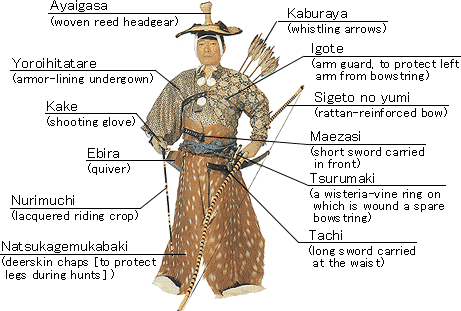
It is a little known fact that before the samurai of ancient Japan incorporated the sword into their martial arts training, the samurai practiced the classical fighting arts of the bow. The Japanese martial art of shooting a bow with incredible accuracy while on horseback became known among the samurai as "The Way of the Horse and Bow". In the true fashion of the Japanese culture, they no doubt took a cue from the Mongolians and improved what another culture had to offer.
The bow has become a ritual rather than a practical instrument in Japanese martial arts training. Introduced to the culture in ancient times, it was different from the European bow from which it was derived. The main difference is the handgrip.
In Japanese classical fighting arts, the handgrip of the bow is placed closer to the bottom of the bow tip rather than halfway in between. This makes the top section of the Japanese bow slightly longer than the bottom for a different type of feel.
Up until the 4th Century, archers were considered infantry and traveled on foot. It wasn't until much later, during the 10th Century, that the bowmen took to horseback and martial arts training in the bow became an elite sport of the samurai.
From 1192 to 1334, the Kamukura Period, archery on horseback was used as a part of the samurai's martial arts training to keep them in shape during peacetime.
Over time, this form of archery went from a form of martial arts training to a highly ritualized Japanese martial art: the art of Yabusame. It was believed that each time the arrow struck its target, the energy of the hit and the courage of the rider would be transferred to the audience, and most of all, the gods.
Yabusame today is a very serious ritual among the Japanese. The classical fighting arts of Japan all have something to do with ritual. In fact, there is not one aspect of Japanese culture not bound to tradition or ritual.
Yabusame takes the Japanese martial art of archery and sets it above all others, even that of the sword. This ritual is so sacred it is frequently performed on special occasions reserved for visiting dignitaries, royalty or presidents. At one time only the most skilled warriors were chosen to be Yabusame archers. This was, and still remains, a great honor.
Yabusame, one of the classical fighting arts, is still recognized in Japan. While only two schools in the country continue to teach Yabusame (Ogasawara and Takeda), there are still many skilled students carrying the tradition.
This Japanese martial art training skill still manages to entertain people during festivals and celebrations throughout the country. Though its use is considered more ritualistic and impractical, it will continue to have an appeal for many decades to come.
Knowing the art of martial arts is an asset for protection. Get more useful information about classical fighting arts from Mike Selvon's portal, and leave a comment at his martial art blog.
Learn about art in Japan, art schools in Japan, art colleges in Japan, music in Japan, modern Japanese art, classical Japanese art and all other things art in Japan!
Japanese Historic Woodblock Prints
Unknown woodblock print from the 19th century
Tamamo-no-Mae, the evil kitsune of Japanese legend. Woodblock print by Yoshitoshi, from New Forms of Thirty-Six Ghosts. (1889-1892))
Ukiyo-e woodblock print by Kitagawa Shikimaro, Japanese Edo era: 1600s-1800s
Woodblock print from the mid-1800's by artist Utagawa Kuniyoshi, original currently located in the Brooklyn Museum
Utagawa Toyokuni's Edo period Ukiyo-e woodblock print
Dominic Walsh Choreographs to Japanese Mythology in Uzume
The set-up:
This past weekend, Dominic Walsh Dance Theater presented the world premiere of Uzume, a collaboration with Asia Society Texas Center that showcased the talents of taiko master Kensaku Satou and DWDT staples Domenico Luciano and Hana Sakai.
The execution:
Uzume is inspired by the Japanese myth of how light was brought back into the world. When the storm god Susanowo wreaks havoc on the earth, his sister, the sun goddess Ameterasu, becomes distraught and hides herself inside a cave. There is no convincing Ameterasu to leave her sanctuary until she is captivated by a strange noise. The sound is Uzume, the goddess of the dawn, dancing madly on a wooden tub. Intrigued, Ameterasu leaves her cave, thus bringing light to the world of darkness. It's no wonder that Walsh has turned to this story for inspiration; in this narrative, it is dance that brings light to the world.
The movement is spellbinding. Luciano and Sakai emerge from the washi set design as if they were breathing life into inanimate matter. Their bodies in the opening sequence are mangled and disjointed, each gesture accented with force, each turn of the head punctuated by a spasmodic pulse. Luciano's long body is perfect for the classical maneuvers and familiar poses of ballet that make up half of Uzume's choregraphy. But his magnetism is also a result of his superb attention to detail; what he conveys with his fingers and hands is more than what many dancers are able to convey through their whole bodies.
One of the most exciting sequences is a solo by Sakai that requires her to bourree to the crescendos of the drum. While her feet move in rapid torrents, her upper body contracts and extends in unnatural, yet beautiful, shapes. She dances with verve and supernatural purpose, a swan possessed. The costume design intensifies the ballet/Japanese dance fusion of both Luciano and Sakai and masks the inherent strength of their performance. Moving across the tissue-papered stage, they give the impression of origami dancers set loose on restless wind.
Attention must be paid to the other half of this flawless equation. Taiko drummer Kensaku Satou is a whirlwind of a performer. Having no previous experience with taiko, I was under the assumption that a percussion form from Japan would be a meditative, zen-inducing affair. On the contrary, Satou drumming was an invigorating, life-giving force that not only accompanied the dance, but shaped it.
Taiko, at least Satou's performance of it, encapsulates beat, rhythm and melody. During one pulsating sequence, his drumming had an almost jazzy, funky flair, and he played directly to the audience. In this supremely enjoyable moment, Satou could have been a New Orleans street performer. He certainly has the swagger to match, and a smile bright enough to power the entire Asia Society complex, and then some.
The verdict:
Mesmerizing. Even if the particulars of the Uzume myth are forgotten, the performances of Luciano, Sakai, and Satou will not be. Uzume is like every other Dominic Walsh production: not just a dance concert, but an experience to be cherished forever.
The performance took place this weekend at the Asia Society Texas Center.
http://blogs.houstonpress.com/artattack/2012/10/dominic_walsh_choreographs_jap.php
Matsuri celebrates Japanese culture
LIHU‘E — Matsuri translates to mean festivals, and during the Kanyaku Imin, or 100th anniversary of the arrival of the first Japanese immigrants to Hawai‘i, the Matsuri Kaua‘i was born.
“Last year, we didn’t have a Matsuri because of the earthquake and tsunami in Japan,” Kaua‘i Film Commissioner Art Umezu said. “This year, the Japanese people vowed to return and the Matsuri, the 27th, was again held.”
Saturday, a steady throng of people flowed through the Kaua‘i War Memorial Convention Hall, hosted by the Kaua‘i Japanese Cultural Society, eager to experience the Japanese culture, including the familiar bento, Japanese dance, crafts, and this year, a newly-introduced Kendama skill contest.
The Kanyaku Imin was celebrated in 1985 and the Matsuri seed was nurtured by a group of dancers and karaoke singers to perpetuate the Japanese culture and strengthen Kaua‘i’s bond with the people of Japan, states a mayoral proclamation celebrating the Matsuri Kaua‘i 2012.
Mayor Kazuhiro Miyamoto of Moriyama City arrived with a dozen visitors, stopping to enjoy the ‘ukulele classes with the Lihu‘e Senior Center before joining Tsugio Kawashima in a tree planting ceremony at Kaua‘i High School to reinforce and solidify the Rotary Exchange Student program started by Kawashima who was one of the first people to call and offer help to Kaua‘i following the destruction of Hurricane ‘Iniki in 1992.
These sister city relationships between the County of Kaua‘i and Japan are also part of the Matsuri celebration, Mayor Miyamoto, enjoying his first trip to Hawai‘i and Kaua‘i, offering his greetings to Matsuri guests followed by a program of song and dance by its visitors.
The County of Kaua‘i currently enjoys sister city relationships between the City of Oshima-Gun, Yamaguchi Prefecture, the City of Ishigaki, Yaeyama Gunto, Ryukyu Islands, the City of Moriyama, Shiga, and the City of Iwaki, Fukushima Prefecture.
In addition to the presentations of karaoka, dance, martial arts, taiko drumming, kimono kitsuke for adults and children, chado, or tea ceremony, origami, oshibana, mochi pounding, bonsai demonstrations, and a mini bon dance, two films were offered for free.
“Dale Rosenfeld just saw one of the films and was almost moved to tears,” said Sue Kanoho, executive director of the Kaua‘i Visitors Bureau.
Joyce Takahashi expressed a similar sentiment, referring to “Can You See Our Lights,” a chronicle of the efforts by residents of three northern Tohoku towns, Rikuzentaka, Soma and Minami Soma, as they repaired and rebuilt their lives following the earthquake and tsunami which struck Japan last year.
Despite the challenges the people faced, the townspeople banded together and continue to host their annual summer Obon festivals to honor the souls of the departed.
“Fukushima Hula Girls” follows a troupe of hula dancers from the Spa Resort Hawaiians, a large, Hawaiian-themed park in Iwaki City, as the dancers travel to the devastated areas in Japan, providing encouragement, joy and smiles.
Both films were offered at no charge to Matsuri Kaua‘i guests through the Kaua‘i Film Commission, the Office of Economic Development, and the Honolulu Japanese Consulate.
Matsuri Kaua‘i 2012 is brought to the people of Kaua‘i through the Kaua‘i Japanese Cultural Society, the county’s Office of Economic Development, the Hawai‘i Tourism Authority and the County of Kaua‘i to showcase the island’s different groups’ talents and to perpetuate the Japanese culture.
Gardens in Japan
Arima Grand Hotel of Arima Onsen in Kobe, Hyogo prefecture, Japan
Enjoji in Nara, Nara prefecture, Japan
Byoodoo-in's Pheonix Hall in Uji, Kyoto prefecture, Japan
"Sorakuen" in Kobe, Hyogo prefecture, Japan
Transient Salt Art Exhibits
![]() |
| Motoi Yamamoto’s salt installation called Floating Garden on display at the Halsey Institute of Contemporary Art in Charleston, S.C. in May 2012. |
It’s all part of the creative art process, he says.
Mr. Yamamoto’s monumental salt installations are delicately composed constructions that take hundreds of hours and thousands of pounds of salt to create. And at the end of each exhibit’s run, visitors are invited to literally get to work with a broom and collect salt for returning to the sea.
![]() |
| "Labyrinth" at the Bellevue Arts Museum during an exhibit from March to May 2012. |
This will be the case when Mr. Yamamoto’s exhibit at the Laband Art Gallery, which opened Sept. 8, in Los Angeles, closes in December. The exhibit is his first show on the U.S. West Coast. He has also held exhibits in Tokyo, Kyoto, Milan, Hamburg and Paris.
It hasn’t always been this way. Mr. Yamamoto had been creating salt-based installations for nearly a decade before the idea crystallized of a formal ceremony to return the salt to the sea, back in 2006.
“Before then, I resisted the idea of my art work getting broken up at the hands of other people. That’s probably because the inspiration behind the work – the reason why I use salt – is directly tied to my sister’s death,” said the Kanazawa-based artist. “Because of this connection, in my heart, I was reluctant to let other people intervene.”
In 1994, the artist’s younger sister passed away from brain cancer. They were very close as she was the person who most understood his art, and her death, coming in his early years as an artist, had a huge impact on his work, he said.
To cope with her death, Mr. Yamamoto turned his grief into elaborate art pieces made of salt, an item traditionally used in Japanese funeral rituals. His art has gone on to soothe his grief to the point where he felt able to invite the public to get involved in his installations and help return the salt he uses to the ocean. In this way his art has evolved into something that isn’t only about his sister’s death, but also celebrates life, he says.
In creating his installations, Mr. Yamamoto transforms several tons of salt into intricate wonders of tiny detail: twisting crystalline labyrinths or unlikely canvases of cherry blossom petals. The detailed and mammoth scale of his work conveys vulnerability and a sense of loneliness.
His piece “Utsusemi,” recreated several times since its debut in 1998, is an architectural construction of a crumbling staircase. “It represented how much I missed my sister. I wanted to see her again, but it was impossible no matter how much I felt that way,” he said.
Working with salt in this way is a grueling process. During a previous exhibition this year at the Halsay Institute of Contemporary Art in Charleston, S.C., Mr. Yamamoto spent about 100 hours hunched over with his salt-filled plastic bottle to create the installation on site. It took 10 hours a day for about as many days to make a swirling whirlpool-like image for the exhibit. “It’s like running a marathon,” he said, describing the exhausting process.
Looking ahead, Mr. Yamamoto says he’s not ready to give up his penchant for salt just yet. “I’m not tired of it yet. But at the same time, I don’t think my medium has to be salt in the future. I’m open to other things,” he said.
Mr. Yamamoto has experimented with photography and sketching, but is most widely known for his salt installations.
http://blogs.wsj.com/japanrealtime/2012/09/10/transient-salt-art-exhibits-sweep-up-when-you-leave-please/
Subscribe to:
Posts (Atom)
-
This beautiful photo is from the Takaragawa Onsen. Enjoying a hot, relaxing soak in the onsen while snow piles up around you is a "must...
-
It is a little known fact that before the samurai of ancient Japan incorporated the sword into their martial arts training, the samurai pr...
-
Unknown woodblock print from the 19th century Tamamo-no-Mae, the evil kitsune of Japanese legend. Woodblock print by Yoshitoshi, fr...


