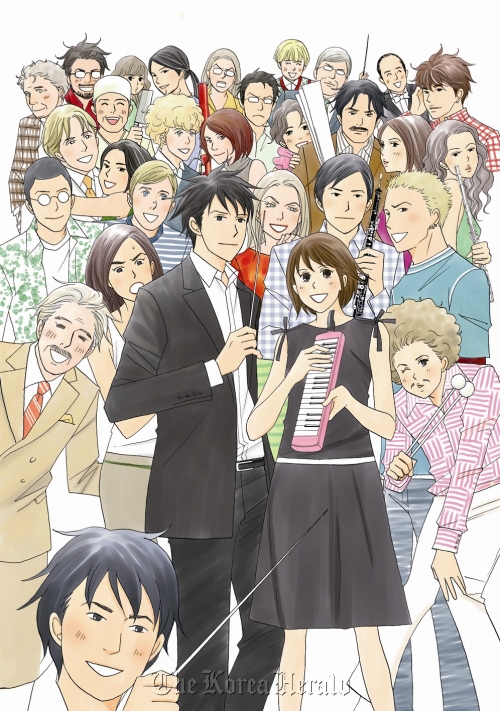
Is Japanese manga moving into mainstream art?


While manga is one of Japan’s most powerful mediums, with a huge influence on many industries including publication, film, games and even electronics, the art world has never quite embraced it as high art.

But now is perhaps the time to change that mindset, as Artsonje Center, a private art museum in Hwa-dong, central Seoul which usually presents contemporary conceptual art, has taken the bold step of opening its space for a special exhibition on Japanese comics.

Organized by SAMUSO and The Japan Foundation, the exhibition “Manga Realities: Exploring the Art of Japanese Comics Today” makes the case for why and how manga should be viewed as art.

“We pondered the question of how manga, which is born to be sold in the form of comic books in book stores, could be displayed at an exhibition. We also questioned the limit of manga; if it should stay as a commercial product and be bought and shared by many people, or become something more. We hope this exhibition will pave the way for more discussions on manga,” Takahashi Mizuki, curator of the exhibition, told the press Friday.

Manga’s sudden intrusion into a lofty art museum definitely seemed to have caught the media’s attention as the museum was unusually packed with journalists on the opening day. Setting aside all the lingering questions, the general response was that the show offers heart-fluttering memories for hardcore manga fans and an easy introduction for manga first-timers. Divided into nine sections, the show features some original illustrations from nine manga strips ― “Number Five,” “The World God Only Knows,” “Sugar Sugar Rune,” “BECK,” “Children of the Sea,” “Solanin,” “Five Minutes from the Station,” “Sennen Gaho” and “Nodame Cantabile.”

“Only the most representative manga that are translated into Korean and widely read here were selected for the show to better reach out to the public,” explained Mizuki.

Unlike in some exhibitions fe aturing comic strips which simply display the original illustrations, exhibition designer Toyoshima Hideki created something like a 3-D realization of the comics by adding whimsical props and installations that look like they just popped out of the comic books.

The section dedicated to Wakaki Tamiki’s “The World Only God Knows,” for example, is presented like a classroom with a chalkboard, a lecturn and 12 desks and chairs, just like it is illustrated in the comics. Brief introductions on the characters are written on the board in adorable handwriting.

The highlight and finale of the show is “Nodame Cantabile,” manga which was also made into a TV series and a movie that were extremely popular in Korea. Original illustrations and rough copies of the manga are exhibited behind a player piano that plays Beethoven’s Sonata Op. 13 No. 8, a significant musical number in the story.

The complete collection of the comics featured in the show are on display on the first floor of the museum. A guide book is distributed to visitors so even those who are not familiar with the original works are able to get a picture of what they are going to see before jumping into the sea of 3-D realized imaginations.

The exhibition runs through Feb. 13 at Artsonje Center in Hwa-dong, central Seoul. Tickets are 1,500 won for students and 3,000 won for adults. For more information, call (02) 733-8945 or visit www.artsonje.org/asc.

By Park Min-young (claire@heraldm.com)

Holy comicbook exhibition, Batman!: Japan's artists put their own twist on America's iconic superheroes

In a publishing market so dominated by illustrated stories--i.e. manga--it is sometimes surprising the only exposure Japanese audiences have to American comicbook superheroes is in the form of blockbuster Hollywood movies.

Using that very point of entry, Parco Factory's latest exhibition, DC Comics Super Heroes!!!, explores a small but significant corner of that increasingly popular American art form.

"We felt this exhibition would be a good way for light fans who became interested in America's comicbooks through films to learn about the genre in an accessible, fun way," says Rui Shigeto, who curated the exhibition.

The show covers the history of some of America's favorite comicbook heroes: Superman, Batman, Wonder Woman and Green Lantern (most of whom have appeared in film). Starting with the Golden Age (ca 1938-1952)--which was heralded by the appearance of Superman in Action Comics No. 1, and later introduced Batman in Detective Comics--a number of replica covers from each era illustrate the changes in artistic attitudes and societal norms.

Each of the major turning points in comicbook history--which also include the Silver Age and the Modern Age--is marked by a distinct approach in terms of both artistic style and story content. Early stories were a bit on the dark side, before taking a turn for the camp during the 1960s. Later, characters struggled with issues such as drug abuse and, in the case of Frank Miller's brilliant The Dark Knight Returns, nuclear war and misplaced patriotism. As one might imagine, a dark realism--both visually and thematically--has taken hold in the Modern Age of American comics.

Hanging on the walls of the exhibition space are recent issues of series dealing with these classic characters, each of them handled by a different writer and artist. Grant Morrison's Old West version of Batman, any one?

"I think one of the interesting things about American comicbooks--as opposed to Japanese manga--is that different artists [and writers] handle the same character, thereby giving the art a different flavor and the storylines a different structure," says Shigeto. "In Japan, you would never see several mangaka taking on the same character's story."

For Super Heroes, however, Japanese artists get to do exactly that: 22 artists and designers try their hands at re-envisioning these classic icons. Shunya Yamashita, who designs game characters, imagines Batgirl, Wonder Woman and Catwoman as kawaii sexpots straight out of anime; illustrator Hiroki Tsukuda applies traditional Japanese craft to an ink recreation of the Batmobile from the recent Batman films; and the designers at Be@rbrick turn Batman into its trademark cute bearshaped toy.

"We wanted to make use of the various styles, genres and ages of the participating artists--which include graphic designers and mangaka, among others--as a filter through which to view the world of American comicbooks," Shigeto says. "I feel that this varied mix really resulted in a particularly 'Tokyo' sensibility. This is an exhibition that really only could have been done here in Japan."

But the most famous redesigns of America's comicbook superheroes have been done by film studios, and there is no shortage of memorabilia on hand at Super Heroes. Among the many items are Val Kilmer's cowl from Batman Forever, Brandon Routh's glasses from Superman Returns and Batmobile and Batwing models from 1989's Batman. And the most impressive of all: the rhinestoned "S" from Marlon Brando's costume for 1978's Superman.

"DC Comics Super Heroes!!!," until Dec. 19, 10 a.m. to 9 p.m. at Parco Factory in Shibuya, Tokyo. Admission is 300 yen, with student discounts available. For further information, call (03) 3477-5873 or visit www.parco-art.com.


http://www.yomiuri.co.jp/dy/features/arts/T101202003565.htm

Japanese Onsen Spa Guide


By , About.com Guide

Japanese spa is called onsen. Since Japan is well-known for its many
volcanoes, there are a lot of onsen all over the country. It is very
relaxing to soak in Japanese onsen spas. Japanese people like to spend
holidays in onsen. Open-air spas (roten buro) are very popular and
are wonderful.

There are different kinds of onsen, depending on the amount and
kinds of minerals in the water. (See Kinds of Onsen) Some spas can
be smelly and very hot.

It's good to know how to use Japanese-style bath before you go to
Japanese spas. Japanese spa are usually separated for women and
men. You are supposed to take all your clothes off. People do not wear
bathing suit in Japanese spas.

Top Onsen in Japan
Great Onsen in Japan

Hot Springs in Japan by Region
(Links by Jolsen's, Japanese Guest Houses, and Onsen Mechelin).

1. Hokkaido
Aidomari onsen, Bifuka onsen, Noboribetsu, Rausu onsen

2. Tohoku Region

  • Akita: Kawarage Ohyudaki onsen
  • Aomori: Kokanesaki Furofushi onsen
  • Fukushima: Yonokami onsen

    3. Kanto Region

  • Ibaraki: Gozenyama onsen
  • Gumma: Ikaho onsen, Kusatsu onsen
  • Kanagawa: Hakone Yumoto onsen
  • Saitama: Chichibu onsen
  • Tochigi: Shiobara onsen

    4. Chubu Region

  • Gifu: Hirayu onsen, Gero onsen
  • Nagano: Shirahone onsen, Nozawa onsen
  • Shizuoka: Shuzenji onsen

    5. Kinki Region

  • Kyoto: Kurama onsen
  • Hyogo: Arima onsen
  • Wakayama: Kawayu onsen

    6. Shikoku Region
    Dogo onsen

    7. Kyushu Region

  • Kagoshima: Ibusuki onsen
  • Oita: Yufuin onsen


  • http://gojapan.about.com/cs/traditionculture/a/hotsprings.htm

  • New exhibition charts Japan's influence on the world of haute-couture

    LONDON (Kyodo) -- The first exhibition in Europe to comprehensively survey avant-garde Japanese fashion has just opened at the Barbican Art Gallery in London.

    The display shows how Japanese designers took the world by storm in the early 1980s and how they have continued to have a presence on the international stage.

    Works from icons Issey Miyake and Kenzo Takada are among more than 100 garments from the last three decades that have been loaned by the Kyoto Costume Institute.

    The exhibition starts with fashions from the early 1980s, when designers like Rei Kawakubo of Comme des Garcons and Yohji Yamamoto gained critical acclaim for their asymmetrical, deconstructed garments -- where raw edges, exposed seams and distressed textiles give the clothes an unfinished look -- in monochrome palettes.

    They rejected the then current obsession with body-consciousness by concealing, rather than revealing, the figure, often in loose swathes of fabric. Commentators called their designs "bag-lady chic" when they exploded on to the scene in Paris.

    The display goes on to show how Japanese designers have sometimes used synthetic materials to create innovative designs, as well as employing traditional techniques with a modern twist.

    Visitors are able to see the "techno couture" of designer Junya Watanabe, whose honeycomb-structured dresses made out of polyester are particularly striking.

    There are also a series of paper garments based on origami techniques from Hiroaki Ohya and Tao Kurihara.

    The exhibition also features Kenzo Takada's modern take on the traditional kimono.

    The final section of the gallery is dubbed "Cool Japan" and shows work from a new breed of designers who have been influenced by manga, anime and the "kawaii" (cute) culture epitomized by the Hello Kitty brand.

    It features pieces by Kurihara, Ohya and Jun Takahashi for the Undercover label.

    Here, there is a mixture of styles with some pieces being described as "Lolita", "Gothic", "Victorian" or "Rococo."

    Akiko Fukai, director of the Kyoto Costume Institute, told Kyodo News, "From 1980 Japanese designers are trying to remake the western notion of beauty. Before then, nobody knew about Japanese fashion.

    "From 1980 the West started to become interested in Japanese designers, who brought a new aesthetic into the fashion world: deconstruction, slashed or tiered clothing. Japanese designers focused on black, grey and white while European designers were focusing on color."

    But she admits that Japanese designers now are not as influential as they were in the 1980s.

    Despite this, Fukai believes an exhibition in Europe is now well overdue given the wealth of talent in Japan.

    Kate Bush, head of art galleries at the Barbican Centre, said, "The great Japanese designers -- Rei Kawakubo, Issey Miyake and Yohji Yamamoto -- changed fashion forever in the 1980s.

    "The tight silhouettes of western couture were jettisoned for new fluid shapes. Out went the magnificent ornament and extravagant techniques of the postwar tradition and in came a stark, monochrome palette and an entirely new decorative language -- holes, rips, frays and tears -- emerging from the stuff of fabric itself."

    "Future Beauty: 30 Years of Japanese Fashion" is on at the Barbican Art Gallery in London until Feb. 6.

    Japanese Village Creates Art From Hues of Rice


    INAKADATE, Japan — Nearly two decades ago, Koichi Hanada, a clerk in the village hall, received an unusual request from his superior: find a way to bring tourists to this small community in rural northern Japan, which has rice paddies and apple orchards, but not much else.

    Mr. Hanada, a taciturn but conscientious man, said he had spent months racking his brain. Then, one day he saw schoolchildren planting a rice paddy as a class project. They used two varieties of rice plants, one with dark purplish stalks and the other bright green ones. Then it struck him, why not plant the colored varieties in such a way as to form words and pictures?

    “I didn’t know it would become such a hit,” he said.

    The result was what is now called paddy art, and it has put this village on the map. Every year since 1993, villagers have created pictures by using rice paddies as their canvas and living plants as their paint and brush. As the village’s creations have grown increasingly large, complex and polychrome, they have drawn growing media attention and hordes of the curious.

    Last year, more than 170,000 visitors clogged the narrow streets of this quiet community of 8,450 mostly older residents, causing traffic jams and waiting for hours to see the living art.

    Indeed, the images may be possible only in Japan, as the product of an amalgam of high technology, painstaking perfectionism and an ancient attachment to rice. To create this year’s football field-size picture of a samurai battling a warrior monk, villagers used a computer model to place more than 8,000 stakes to guide them in planting rice plants genetically engineered to produce three more colors: dark red, yellow and white.

    The images have become so detailed that the mayor, Koyu Suzuki, says visitors often ask if they are drawn on the paddies with paints. He said that it was the surprise factor that brought people here, and that the villagers believed they must produce ever more intricate pictures for tourists to keep coming back.

    “We have no sea and no mountains, but what we do have plenty of is rice,” said Mr. Suzuki, 70. “We have to create a tourism industry using our own ingenuity.”

    Residents of Inakadate (pronounced ee-NAH-kah-dah-tay) hope the paddy art will revitalize their declining village. Like much of rural Japan, the village has fallen on hard times from a shrinking population, a crushing debt load and declining revenues from agriculture.

    “So many things have gone wrong, but the paddy art lets the community feel together again,” said Kumiko Kudo, 73, who runs a noodle restaurant.

    But so far, the village has failed to turn its accomplishments on the rice paddies to its financial benefit. The visitors who now flood the village during the summer growing season, when the rice stalks grow tall enough for the pictures to become visible, do not spend much.

    “Tourists come, say how wonderful it is and then just leave,” said Katsuaki Fukushi, the head of the village hall’s economic section.

    Before the paddy art, the village’s only claim to fame was the discovery here in 1981 of the archaeological remains of 2,000-year-old rice paddies, making it one of the oldest rice-growing regions in sparsely populated northern Japan. The village tried to capitalize on the discovery by building a Neolithic-themed amusement park during the better economic times of the 1980s, when Tokyo showered regions with money for public works.

    The public works spigot has since dried up, and the park now sits weed-filled and often empty. The park is one reason the village is now saddled with a debt of $106 million, three times as large as its total annual budget.

    Villagers say the less expensive paddy art is better suited to the current leaner era. The paddies cost just $35,000 per year to rent, plant and maintain. While the village does not charge visitors to see the paddy art, it does ask for donations, which last year brought in $70,000, more than enough to cover the costs.

    On a recent afternoon, throngs crowded an observation deck at the top of the village hall, which is built in the shape of a medieval Japanese castle, to see the paddy art below. Most praised Inakadate for its ingenuity.

    “Other parts of Japan need to learn this spirit,” said Masako Sato, 69, a retired teacher from Akita, five hours away.

    Volunteers plant and maintain the paddies. In the spring, about 1,200 villagers turned up to plant the half-dozen paddies for this year’s spectacle. That is a far cry from the first art in 1993, when Mr. Hanada and 20 fellow workers from the village hall made a simple, two-colored design representing a nearby mountain.

    Along the way, the project has learned from its mistakes. In 2003, a picture of the Mona Lisa ended up looking pregnant, Mayor Suzuki said, because she was too narrow at the top and bloated at the bottom. To correct the sense of perspective, the villagers asked a teacher here to use a computer to map out where to plant stalks so the pictures would have proper proportions when viewed from atop village hall.

    The village has also spawned imitators. At least a half-dozen other communities across Japan now create pictures in paddies, though none seem as intricate.

    Feeling that they have been left to fend for themselves by Tokyo’s spending cuts, villagers say they must find ways to capitalize on the influx of visitors. Yozo Kikuchi, the head of the Chamber of Commerce, says the village must develop new souvenirs. True to form in Japan, they include a cute mascot, a smiling grain of rice named Little Mr. Rice-Rice.

    The mayor has grander plans. He envisions increasing the number of paddy art sites and building new facilities for visitors, including possibly a flower-lined road, to turn Inakadate into an “art village.”

    “We used to treat economic benefits as an afterthought,” said Eiji Kudo, head of the village council. “Now we realize how important they are.”

    Call to forge a common East Asian culture


    The shared characteristics of East Asian countries, including China, South Korea and Japan, provide a basis for establishing a common cultural community, experts say.

    These characteristics include Confucianism, Buddhism, written Chinese characters as a communication tool, treating humans as part of nature, the emphasis on the community over the individual and the realization of harmony from contradictions, according to Professor Jin Ryong Yoo, of South Korea's Eulji University.

    He was speaking at the First High-Level Academic Forum for Asian Culture and Art Circles, held last week in Chengdu, Sichuan province.

    "The world is heading toward a multi-polar system under which regionalism has become an essential element of globalization. It is time to put our efforts to form a cultural community based on a common emotional background before setting up a political and economic community," Yoo says.

    East Asian values, he says, have played an important role in the success of some Western cultural products, such as Hollywood's Mulan, Crouching Tiger, Hidden Dragon, and even in Avatar, which has been seen by some to be based on the Taoist ideas of Lao Tzu and Chuang Tzu.

    A cultural community of East Asian countries will help them reap the benefits of scale economies in the world cultural industry, he adds.

    Calling the culture industry a "sunrise industry", Professor Qi Yongfeng, of the National Research Center of Cultural Industry, Communication University of China, says: "Promoting regional cooperation and communication in Asian cultural industry will not only help optimize and upgrade the economic structure of Asian countries, but also push forward the course of economic integration."

    Besides, it will also help remove historical misunderstandings and increase mutual political trust, he says.

    According to statistics quoted by Korea Creative Content Agency, in 2009 China accounted for only 4 percent of the world's contents market, but the share of Asian countries, including China, South Korea and Japan, was 22.9 percent. In contrast, Europe's share was 36.6 percent and North America's, 35.7 percent.

    "Independently, South Korea, China and Japan may not find it easy to overcome the United States' absolute superiority. But cooperation among East Asian countries can help in the long run," Yoo says.

    He adds that China, South Korea and Japan must build a new common cultural consciousness that is different from that of other regions by confirming their emotional identity while comprehending their differences.

    This can be done, he says, through common management of and research into the cultural assets of East Asia, cultural exchanges, and cooperation in setting up a legal system for the culture industry.

    According to the Annual Report on Development of China's Cultural Industries (2010) by the Chinese Academy of Social Sciences, China produced 456 feature films in 2009, ranking third in the world, after the US and India, with the year's domestic office box income increasing 42.96 percent over the previous year.

    Jia Leilei, a research fellow with Chinese National Academy of Arts and one of the sponsors of the forum, says that while the Chinese cultural industry is developing rapidly, it still lags behind developed countries. "We cannot make a film like Avatar overnight. We need more time to acquire the skills for this," he says.

    The forum, initiated by the Chinese National Academy of Arts and Korean-China Culture and Arts Forum, attracted more than 50 participants from various Asian countries.


    http://www.chinadaily.com.cn/life/2010-05/11/content_9833575.htm