Rape Victim Presses Case of Police Abuse in Japan


Run Date: 01/02/09
By Catherine Makino
WeNews correspondent


In Japan, rape is often kept hush-hush. But the high-profile case of one rape victim is challenging the silent treatment and raising questions about police practices. 'Jane,' as the victim is known, is suing police who required her to re-enact the crime.

(WOMENSENEWS)--An Australian woman who was raped by a U.S. Navy sailor in Japan in 2002 has settled the score, at least for the time being, with her assailant.


"Jane" as she calls herself, filed a civil suit against her assailant, a Wisconsin man named Bloke Deans, after the police here failed to bring criminal charges against him. In November 2004, she was awarded $49,555 in compensation from Japan's Ministry of Defense.


Now she's focused on what she calls her second rape by police officers at the nearby station where she sought help after the attack. The police didn't literally rape her, but they asked her to re-enact the crime in a way that she says left her feeling doubly assaulted.
She is seeking $182,000 in compensation.


She also says she's pressing the case to change a culture that prevents many women from bringing charges. "It is a silent culture where nobody says anything. But things are changing as more women begin to speak out," she told Women's eNews.


Although Jane has kept her real name out of news coverage, she has nonetheless become famous in Japan for talking about the taboo topic of her rape.


She sued the Kanagawa police for mistreatment and last week a judge dismissed her case in Tokyo's High Court.


Jane's lawyer, Mami Nakano, criticized the ruling. "If this kind of idea is tolerated in society, it would hinder rape victims from reporting their cases to police," she said.


In statements to the courts, the Kanagawa police have argued they are not obligated to provide rape victims with underwear or showers and it is an unreasonable request that investigations require the participation of a female officer. The police also said that because rape victims do not need urgent medical treatment they are not required to take them to emergency rooms and they do not believe Jane's assertion that she was too depressed by the crime to return to the scene. Taking re-enactment photos is normal protocol.


On Dec. 22 she appealed to Japan's Supreme Court. Jane says more than 40 lawyers from Kanagawa, Tokyo and Yokohama have offered to represent her appeal for free.


Rape in Van in Parking Lot


In the port city of Yokosuka, Jane was raped six years ago in her van in a parking lot after she left a bar in the early hours.


She says Deans, who was discharged from the USS Kitty Hawk in November 2002, has been allowed to avoid punishment by an unresponsive U.S. government despite her requests to learn how his case would be handled.


"I have been asking since the day I was raped," she says. "I even wrote letters to President Bush, Condoleezza Rice, the U.S. military and government officials. They still have not gotten back to me."


Jane alleges that after the rape, she went to the police who then kept her in custody for 12 hours. She was afraid they would arrest her if she left and says she was in shock. The police moved her from a small room, then to the scene of the crime, then back to the station in a large room with other people.


She claims she was not fed, allowed to see a doctor, or given fresh underwear.


"I went to the Japanese police to seek help, sadly they didn't believe me," said Jane, who made her standard request for anonymity to protect the privacy of her three sons. "They interrogated me for several hours and the entire time I begged them to take me to the hospital. But they said I wasn't hurt enough and, if I was, then I had to show them where. I was told that on-duty doctors are for urgent patients and rape victims were not urgent."


Asked to Re-Enact the Crime


The worst offense, she says, occurred two months later, when the Kanagawa police asked her to return to the station to help investigators take re-enactment photographs. The photographer asked her to assume the various positions that the rape entailed. Incapable of doing so, Jane gave instructions to male and female officers so the photos could be taken.


"I was forced to become the director of my own rape," Jane says. "Re-enactment photographs must be banned. No human being should have to go through that. The police treated me without compassion or dignity."


Michael O'Connell, commissioner for Victim's Rights Australia, a government advocacy group, calls it one of the worst cases of police re-victimization that he has ever encountered.
"On hearing about Jane's plight, I was appalled that a victim of sexual assault would be treated with so little respect and dignity," he said in an e-mail to Women's eNews. "Internationally, the most progressive police know that their responsibilities to victims include protecting the victim, collecting and preserving evidence, and supporting the victim."


A report in late October by the United Nations Human Rights Committee found Japanese police practices in rape cases insufficient under the International Covenant on Civil and Political Rights. It also found a shortage of doctors and nurses in Japan trained to handle sexual violence and raised concern about weak-to-nonexistent punishment of sexual violence.


Call for Rape Crisis Centers


"Japan urgently needs to develop a national network of rape crisis centers and hotlines, linking different professionals to support sexual assault victims," Dr. Hisako Motoyama, executive director of Asia-Japan Women's Resource Center in Tokyo, said in a recent interview. "We definitely need to reform our out-of-date criminal justice system, including review of the penal code, systemic training of judges and prosecutors, and enforceable guidelines."


Rape is widely regarded as one of the most shameful experiences in Japan, said Dr. Hisako Watanabe, a child psychiatrist and assistant professor at Keio University in Tokyo who has treated rape victims, including small children, for 35 years. Many victims, she said, suffer the aftermath on their own, without proper medical and mental care or any chances of suing the perpetrator.


In 2006, Japan's Gender Equality Bureau released a study finding that of 1,578 female respondents around 7 percent said they had been raped, at least once. Of those, only about 5 percent--6 out of 114--reported the crime to the police. Of those who remained silent, nearly 40 percent said they were "embarrassed."


"The public assumption in Japan continues to be that rape does not exist; therefore there isn't any need for 24-hour rape crisis centers or support groups," Watanabe said. "Rape is still considered rare and, even when it happens, the victim could be suspected of having enticed the perpetrator into the act. Such an attitude by people around the victim could be more detrimental than the trauma of rape itself."


Catherine Makino is currently the Japan foreign correspondent for Inter Press Service and is president of the Foreign Correspondents' Club of Japan. She has worked for numerous other major publications and broadcasters.

Expert in Japanese tea and flower arranging traditions demonstrates in WNC


ASHEVILLE – Devotees of Japanese culture are in for a treat next week when a renowned expert in Japanese art forms — including tea ceremony and ikebana, or flower arranging — shares her knowledge at a meeting of the Asheville chapter of Ikebana International.

Emiko Nishiwaki, cultural liaison from Japan to Western North Carolina, and Choy Falvey, owner of Choy's Flowers and Ikebana in Hendersonville, will present a traditional tea ceremony and a program on kimonos at 10 a.m. Feb. 24 at the Folk Art Center. The public is welcome.
Nishiwaki, who comes from the small town of Agui, Japan, is a master of ikebana in Kyoto, Japan, and a master in the art of tea ceremony, which represents the essence of Japanese culture.


Since August 2007, she has been the Japanese Outreach Program coordinator at Western Carolina University, bringing the Japanese cultural spirit to students in kindergarten through high school, as well as civic organizations, through ikebana, tea ceremony and other aspects of Japanese culture. The program is supported by the Japan Foundation, an affiliate association of the Japanese Ministry of Foreign Affairs.


One of the most easily shared cultural exchanges comes through flowers — the key component of ikebana.


This ancient and disciplined art form brings creative expression through plant materials by applying certain rules of construction. Line, color, space, contrast, texture and other design teachings bring humanity and nature in harmony to create both beauty and a sense of calm to those who create ikebana.


The need for a sense of harmony is universal, Nishiwaki said in an interview.
“Japan is very fast now, very busy,” she said. “But once a week, I can listen to water sounds, listen to the winds … people in modern life need meditation, and I need it too.”


Nishiwaki said she was raised with Western ways and wasn't particularly interested in the centuries-old rituals of her ancestors. But when she traveled in Europe as a teenager and found many Westerners eager to learn more about her heritage, she decided to explore her history and its art forms.


Today, she is excited to share her knowledge with anyone who is interested, and particularly enjoys being in school classrooms in Western North Carolina teaching children about origami, Japanese folk dance and tea ceremony — a ritual that, in Japan, can last as long as five hours, she said.


“This is a great opportunity for me to be here, to see this grassroots exchange of culture,” Nishiwaki said. “I am also learning about American culture, and Asheville is a very nice place to study because it's such an artistic place.”


Sally Robinson, president of the Asheville chapter of Ikebana International, who is hosting Nishiwaki through July in her Montreat home, said she became enchanted with Japanese culture when her husband's job took them to Tokyo for seven years in the 1970s.


“Everyone is really looking forward to the program on the 24{+t}{+h}, and I hope a lot of people will come,” Robinson said. “I think the world needs what Emiko is talking about … quiet times and appreciation of simple beauty. I believe that's important for all of us.”

http://www.citizen-times.com/apps/pbcs.dll/article?AID=2009902160302

Samurai archery, an ancient sport, still thrives


By ERIC TALMADGE


ZUSHI, Japan (AP) — It is about as far from the Olympic sport of archery as it can get. The bow is taller than the person shooting it, and, to the uninitiated, it appears lopsided and unbalanced. There are no sights, no high-tech stabilizers.

And, of course, it is done on horseback, at upward of 40 mph.

It's called yabusame, and it is the sport of the samurai.

Each year, archers in feudal shooting gear climb atop their decorated mounts for a lively competition on the beach of Zushi, a town just south of Tokyo, galloping in the sand as thousands of onlookers cheer and shout. The first competition was held here in 1199.

The scene is like something out of a movie by the great Akira Kurosawa. Banners flap in the ocean wind marking the beginning and end of the shooting runway. Little boys in bright robes and black hats scamper about collecting the arrows and the debris from the wooden or clay targets destroyed by each hit.

"There is nothing like this outside of Japan," said Ietaka Kaneko, who heads the Japan Equestrian Archery Association and the Takeda School of Horseback Archery, which traces its origins back more than 800 years.

The targets, held about seven feet aloft on small poles or scaffoldings, are roughly the size of a mounted opponent's chest. There are three along the runway, which is only 165 yards long, giving the archer just enough time to raise his bow, load and shoot — three times — all the while spurring on his horse.

When the dull, turnip-shaped tip of an arrow strikes just right, the board explodes in a blur of splinters. But as often as not, the arrows miss, sailing past the targets and thudding into the canvas behind them.

In battle, hitting the target was the whole idea. But yabusame has from its origins been almost as much an art as a sport. In many competitions, hitting the target is almost an afterthought — archers are judged, if they are judged at all, on the beauty of their run and the form they display as they release each arrow.

Here, hitting counts.

"Many schools today see yabusame as more of a ceremonial thing," said Kaneko, a retired veterinarian. "In our school, it is our earnest desire to connect."

Each score brings a loud round of awed cheers and raucous applause and each splintered target is branded with a hot iron commemorating the day and recycled as a good luck charm. A long line stretches along the beach well before the competition is over as spectators make sure they go home with a piece for their collection.

Yabusame in Japan is something like polo in England, or rodeos in America.

Very few people actually participate in yabusame, because few have access to horses or the time to learn all the technique involved in riding them for sport. But Kaneko, whose family roots are in the now-defunct samurai class, grew up around them and his steeds were trained specifically for archery competitions.

"I have been shooting since I was 17," he said. He's 87 now, and was on hand to officiate at this year's beach competition, though he did not shoot at any targets. Instead, he started it all off, as drums beat, with a symbolic draw at the cloud-filled sky.

"The most difficult part is staying absolutely stable no matter how fast the horse is galloping," he said. "The style is not like Western or European equestrian riding."

Archers don't actually sit. They squat, using special stirrups and very light saddles.
There are three main types of shooting.

The first, and most common, involves releasing the arrow at a target directly to the side of the archer from about 10 feet. Targets can also be placed obliquely to the front of the archer's path, or up to 50 feet away.

"When people think of the samurai, they don't realize that in the old days, archery was more important in battle than swords," said Hisashi Yoshimi, one of the featured shooters at the beach competition. "Archers didn't shoot at targets close up. They kept a distance and fired upward so that the arrows would rain down on advancing troops."

Yoshimi said that tradition is reflected in the longbows, which are better suited for long-range attacks on a general area rather than picking off single adversaries.

"The bows haven't really been adapted for this kind of shooting, because there is a big part of the sport that is spiritual, rather than practical," he said. "That's a lot of its appeal."

http://www.google.com/hostednews/ap/article/ALeqM5jDHl8FFiJ7cZ1fqDG9kHU-1jjfewD95GD28O0

Azuchi Momoyama Period Art


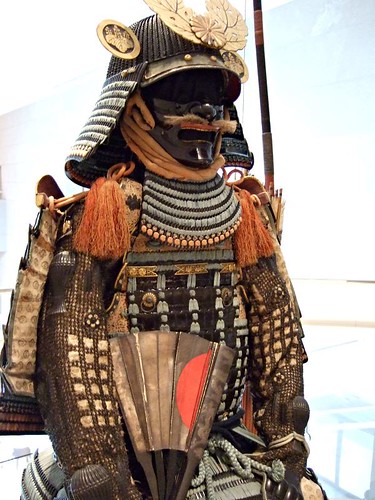
Suit of Armor flanked by sword and bow Japan Late Momoyama period-early Edo period early 17th century
http://www.flickr.com/photos/44124324682@N01/424133311/


Cherry Blossom Viewing (detail), Momoyama period (1573–1615), 17th centuryKano Naganobu (1577–1654)Pair of six-panel folding screens; ink, color, and gold on paper; each 58 7/8 x 11 ft. 8 1/4 in. (149.4 x 356.1 cm)Tokyo National Museum, National Treasure

http://www.metmuseum.org/special/Oribe/8.L.htm


Hasegawa Tohaku. Pine Forest. Momoyama Period. 16-17th C
http://instructional1.calstatela.edu/bevans/Art101/Art101B-11-Japan/WebPage-Full.00027.html

Gift Of Conservation From Japan Comes To Houston Museum

In January 2009, the Museum of Fine Arts, Houston, will unveil a pair of 17th-century six-paneled screens from its permanent collection newly restored by conservation experts in Japan.
The screens were among only nine objects selected last year from prestigious Asian collections around the world for a competitive conservation program overseen by Japan’s National Research Institute for Cultural Properties.

The MFAH will present the transformed screens, last shown at the museum in 2005, in Art Unfolded: The Gift of Conservation from Japan from January 17 through February 22, 2009 in the Caroline Wiess Law Building. The exhibition will feature a presentation describing the conservation process, including materials used, and a video of the Hie Sanno festival depicted on the screens. The screens, titled Hie Sanno Sairei-Zu, will eventually be the centerpiece of a new MFAH gallery devoted to Japanese art scheduled to open in winter 2009-2010.

Conservators at the Association of Conservation for National Treasures, Kyushu Branch Studio at the Kyushu National Museum, carefully implemented their conservation of the Hie Sanno screens over nine months. They treated the painted panels of the screen for surface damage and pigment deterioration, replaced the backing and border fabrics of the panels, and reattached the original metal fittings.

"Japan’s passion for the preservation of tradition and art is well-recognized, and the museum is fortunate to be the recipient of that passion," said Wynne Phelan, MFAH conservation director. "The masterful work of the Kyushu experts has guaranteed the long-term preservation of the screens."

The Hie Sanno Sairei-Zu screens derive from the practice of painting panoramic views of the city of Kyoto and its environs that evolved in the 16th century. Festival screens adopt the same elevated vantage point and panoramic presentation as city view paintings, but also have a unique narrative and anecdotal quality. Festival screens became an independent subject matter in the Momoyama period (1573-1615), and are often remarkably faithful to the topography and events being portrayed.

The Hie Sanno festival is held every April in tribute to peace and a rich harvest. It dates from 1072 and takes place at the Hiyoshi Taisha Shrine in Sakamoto, an historic village on Lake Biwa that lies at the foot of Mount Hie, near Kyoto. Sairei in the title of the screens means festival and Zu means diagram or illustration.

The MFAH screens, each about 5 feet by 12 feet, describe the village and shrine complex set against the beautiful landscape around Lake Biwa. The narrative of the screen reads right to left. The upper middle part of the right screen shows the Hiyoshi Taisha Shrine complex. A distinctive large red gate (torii) marks the boundary of the shrine’s sacred space.

The Jinko-sai, the great procession of large portable shrines from other villages, departs through the Hiyoshi Taisha Shrine’s red gate toward Sakamoto. The heavy shrines are transported by many men as other men on horseback oversee the proceedings. In the left screen, villagers watch as the portable shrines are carried onto boats on Lake Biwa to return to their villages.
Hie Sanno Sairei-Zu was given to the museum in 1996 as a bequest of Mrs. Dudley C. Sharp, Sr., who was a generous supporter of Asian art at the MFAH. -- www.mfah.org

http://www.huliq.com/13/74758/gift-conservation-japan-comes-houston-museum

6th Asian Print Awards (2008 APAs) Presented in Singapore; Recognizing Innovations and Outstanding Achievements Across Asia

Singapore, Nov 30, 2008 (ACN Newswire via COMTEX) -- The 6th Asian Print Awards took place at the Shangri La Hotel in Singapore on Friday night, November 28, at a gathering of Asia's leading print professionals and print manufacturers. The event featured more than 20 awards with over 700 participants witnessing first hand the creme de la creme of Asian printers.
Paul Callaghan, Chairman of Asian Print Awards (APA) said, "Print is relevant to most businesses. Such a visual industry requires the recognition and support from its peer members to encourage higher standards and the continual pursuit of the highest possible quality. The event is a platform to showcase the works of even the most humble business alongside with the main industry players to allow a true exhibition of the capabilities present in Asia.

"The objectives set out by the Asian Print Awards are to recognise the best Asia has to offer in all areas of print and packaging production. 'Achieving excellence' and being awarded a medal is the ultimate accolade that Asian companies can strive for. To ensure the value of the awards, fair play is strictly enforced and entries are judged through coded entry numbers to guarantee that neutrality takes place."

The 6th APA has always enjoyed strong support in the Asian print community from countries such as China, Hong Kong, Japan, India, Indonesia, Malaysia, Mauritius, Philippines, Singapore, Sri Lanka, Thailand and Vietnam. This year there is also a huge influx of entries from Japan; an estimate of 250 more entries than the previous year as the awards gain more recognition in Asia. Winning gold at the APA took more on quality than before as jurors said that relevance and excellence were just basics for consideration. Entries have to ensure an element of precise print fineness to win gold.

"It must be remembered that this competition is judged on the quality of the print, it does not matter how fancy or clever a design may be or the number of processes used, the ultimate goal is to achieve print excellence," said Alf Carrigan, chairman of the judging panel for APA.
This evening of celebration has covered all areas of print production, with special focuses on Platinum Sponsor Awards including: Best in digital colour proofing - Epson; Best use of the digital printing process - Fuji Xerox; Best application of creative colour - GMG, Best in Sheetfed offset - Heidelberg; Best in innovative printing - Kodak; Best in more than one production process - Phoenix Blankets; Environmental Printer Awards - technotrans; Best in web offset printing - UPM; and Best in packaging printing and converting processes - Bottcher Systems.

- 6th Asian Print Awards '2008 APA' Winners - 1. Posters, Showcards

Gold - Cyberprint Company Limited - Thailand
Silver - Aksorn Sampas Press (1987) Co. Ltd - Thailand
Bronze - Yamada Photo Process Incorporation - Japan
Bronze - Taisei Futaba Industry Co. Ltd - Japan

2. Leaflets, Flyers, Folders and Brochures

Gold - Taisei Futaba Industry Co. Ltd - Japan
Silver - Ramya Reprographic Pvt Ltd - India
Bronze - Pragati Offset Pvt Ltd - India
Bronze - Aksorn Sampas Press (1987) Co. Ltd - Thailand

3. Postcards and Greeting Cards

Gold - Phongwarin Printing Ltd - Thailand
Silver - Taisei Futaba Industry Co. Ltd - Japan
Bronze - Supornchai Die-cut Part Ltd - Thailand

4. Multi-Piece Productions and Campaigns

Gold - PT Suburmitra Grafistama - Indonesia
Silver - C&C Offset Printing Co Ltd - Hong Kong
Bronze - Cross Incorporation - Japan
Bronze - Trinity Publishing Co Ltd - Thailand

5. Catalogues, Booklets

Gold - Cyberprint Company Limited - Thailand
Silver - Urano Co. Ltd. - Japan
Bronze - C&C Offset Printing Co Ltd - Hong Kong
Bronze - Yamada Photo Process Inc - Japan

6. Sheetfed Magazines

Gold - BHS Book Printing Sdn Bhd - Malaysia
Silver - SPH Magazines Pte Ltd - Singapore
Bronze - Amarin Printing & Publishing Public Co Ltd - Thailand
Bronze - Silverpoint Press Pvt Ltd - India

7. Calenders

Gold - Thomson Press India Limited - India
Silver - Pragati Offset Pvt Ltd - India
Bronze - Cyberprint Company Limited - Thailand

8. Limited Editions and Art Reproductions

Gold - C&C Joint Printing Co (HK) Ltd - Hong Kong
Silver - Pragati Offset Pvt Ltd - India
Bronze - Cyberprint Company Limited - Thailand
Bronze - Li Feng Ya Commercial Printing (Shenzhen) Pte Ltd - China

9. Book Printing (Less than 4 colours)

Gold - Everbest Printing Co Ltd - China
Silver - C&C Joint Printing Co (HK) Ltd - Hong Kong
Bronze - Shoeido Printing Co Ltd - Japan

10. Book Printing (4 or more colours)

Gold - C&C Offset Printing Co Ltd - Hong Kong
Silver - Eins Corporation - Japan
Bronze - Sirivatana Interprint Co Ltd - Thailand
Bronze - Everbest Printing Co Ltd - China

11. Packaging offset printing

Gold - K.P.P. Packaging Pte Ltd - Singapore
Gold - Shanghai Jielong Art Printing Co Ltd - China
Silver - Linocraft Printers Sdn Bhd - Malaysia
Bronze - Printing Solution Co Ltd - Thailand

12. Web Offset (Coated Stock 70gsm and up)

Gold - Sirivatana Interprint Co Ltd - Thailand
Silver - Shanghai Li Feng Ya Commercial Printing (Shenzhen) Pte Ltd - China
Bronze - C&C Offset Printing Co Ltd - Hong Kong

13. Web Offset (LWC 65gsm or less)

Gold - Times Printers Pte Ltd - Singapore
Silver - C&C Offset Printing Co Ltd - Hong Kong
Bronze - Ringier Print (HK) Ltd - Hong Kong

14. Digital Printing Electrographic/Laser

Gold - PT Suburmitra Grafistama - Indonesia
Silver - Soontorn Film Co Ltd - Thailand
Bronze - C & C Security Printing - Hong Kong

15. Digital Printing Ink Jet

Gold - Standard (Chan's) Co - Hongkong
Silver - Asahi Advertising Incorporation - Japan
Bronze - Shivang Creations Private Limited - India

16. Embellishment

Gold - Sirivatana Interprint Co Ltd - Thailand
Silver - Leo Paper Products Limited - Hongkong
Bronze - Winson Press Pte Ltd - Singapore

17. Self Promotion

Gold - Pragati Offset Pvt Ltd - India
Silver - Leo Paper Products Limited - Hongkong
Bronze - ICR Co. Ltd (International Creative Room) - Japan

18. Innovation in Printing

Gold - Siam Offset Co Ltd - Thailand

19. Speciality Printing

Gold - C&C Offset Printing Co Ltd - Hong Kong
Silver - Morio Co Ltd - Thailand
Bronze - Prodon Enterprises - India

20. Digital Colour Proofing

Gold - Sirivatana Interprint Co Ltd - Thailand
Silver - Schawk Imaging (Shanghai) Co., Ltd. - China
Bronze - Siam Toppan Packaging Co Ltd - Thailand

- 2008 APA Platinum Sponsor Awards -
I. Best in Sheetfed Offset - Heidelberg Platinum Sponsor Award
Entrant: Cyberprint Company Limited
Country: Thailand
Prepress: Soonthorn Film
Printer: Cyberprint Company Limited
II. Best Application of Creative Colour - GMG Platinum Sponsor Award
Entrant: Shivang Creations Private Limited
Country: India
Prepress: Shivang Creations Private Limited
Printer: Shivang Creations Private Limited
III. Best in Digital Colour Proofing - Epson Platinum Sponsor Award
Entrant: Sirivatana Interprint Co Ltd
Country: Thailand
Prepress: Sirivatana Interprint Co Ltd
Printer: Sirivatana Interprint Co Ltd
IV. Best Use of the Digital Printing Process - Fuji Xerox Platinum Sponsor Award
Entrant: PT Suburmitra GXtra Phoenix Blanket
rafistama
Country: Indonesia
Prepress: Kisah Personal Publishing
Printer: PT Suburmitra Grafistama
V. Best in Innovative Printing - Kodak Platinum Sponsor Award
Entrant: Siam Offset Co Ltd
Country: Thailand
Prepress: Imagin Graphic Co Ltd
Printer: Siam Offset Co Ltd
VI. Best in Web Offset Printing - UPM Platinum Sponsor Award
Entrant: Sirivatana Interprint Co Ltd
Country: Thailand
Prepress: Sirivatana Interprint Co Ltd
Printer: Sirivatana Interprint Co Ltd
VII. Best in Packaging Printing and Converting Processes - Bottcher Systems Platinum Sponsor Award
Entrant: K.P.P. Packaging Pte Ltd
Country: Singapore
Prepress: K.P.P. Packaging Pte Ltd
Printer: K.P.P. Packaging Pte Ltd
VIII. Best in More than One Production Process - Phoenix Blankets Platinum Sponsor Award
Entrant: Hong Kong Economic Times Limited
Country: Thailand
Printer: Cyberprint Company Limited
IX. Environmental Printer Awards - technotrans Platinum Sponsor Award
Entrant: Thumbprints Company Sdn Bhd
Country: Malaysia

2008 APA Gold Sponsors
Agfa, Asian Printing Equipment Centre, CGS Publishing Technologies, Day International, EskoArtwork, Fuji Film, Goss International, Hewlett Packard, Hostmann - Steinberg, IST METZ GmbH, Komori, Konica Minolta, MAN Ferrostaal, MAN Roland, Oce, Ricoh, Dainippon Screen, Thai Print Awards 2007

2008 APA Patrons
Esko Artworks, Canon, KBA, X-Rite (Official Supplier of 6th APA)

2008 APA Supporting Associations
Print & Media Association Singapore (PMAS), The Thai Printing Association, PEIAC, Indonesia Print Awards (IPA)

2008 APA Title sponsor
Messe Dusseldorf GmbH - event organiser of drupa 2008
About Asian Print Awards (APA)

The Annual Asian Print Awards was founded to recognise outstanding achievement in the print and packaging industries across Asia. With more than half the world's population represented in this fast growing area, communication in the form of printed matter links Asia's diverse cultures. It is imperative that such print achievements do not go unrecognised, especially among the population base that Asia enjoys. The entries are judged on a wholly quality oriented set of criteria to ensure that fair play is enacted at all times. To further enforced neutrality, the companies' names will not be disclosed and entries are judged through a coded entry number. The Independent Judging Panel comprises ten highly qualified personnel from within Asia and around the world. Please visit www.asianprintawards.com.sg.

About Callahan Publishing Pte Ltd

Callahan Publishing delivers the only regional printing trade publications in Asia. It closes the knowledge gap between the United States and Europe by delivering the latest development in the Asian markets. The magazines by Callahan Publishing are circulated to more than 11,000 companies in 13 countries monthly, including developing markets like China and Indochina. These magazines are a genuine source of market information for printers, manufacturers and suppliers. It also provides launch platforms for new products introduced to Asia. Please visit www.cpublish.com.sg.

Contact: Callahan Publishing Pte Ltd
116 Lavander Street
Unit 03-02
Pek Chuan Building
Singapore 338730
E-mail: paul[at]cpublish.com.sg
Website: www.asianprintawards.com.sg

http://www.marketwatch.com/news/story/6th-Asian-Print-Awards-2008/story.aspx?guid=%7B3A1BF1B5-E3B9-4AF1-BBAB-3B6141F94803%7D