Learn about art in Japan, art schools in Japan, art colleges in Japan, music in Japan, modern Japanese art, classical Japanese art and all other things art in Japan!
Japanese artist Kusama strikes deal with Louis Vuitton
Tokyo —
Polka dots are Japanese avant-garde artist Yayoi Kusama’s lifelong inspiration, obsession and passion.
And so they’re everywhere — not only on canvases but on installations shaped like gnarled tentacles and oversized yellow pumpkins. As part of her retrospective on exhibit at the Whitney Museum of American Art in New York, they also sparkle as “firefly” light bulbs reflected on water and mirrors.
Kusama’s signature splash of dots has now arrived in the realm of fashion in a collection from French luxury brand Louis Vuitton — bags, sunglasses, shoes and coats.
“Polka dots are fabulous,” Kusama said in a recent interview with The Associated Press, looking much younger than her 83 years in a bright red wig, a polka dot dress she designed herself and one of the new Louis Vuitton polka dot scarves.
Dots aside, Kusama cuts an odd figure for the fashion world. She has lived in a psychiatric institution for decades, battling demons that feed her art.
Still, in her Tokyo studio, filled with wall-sized paintings throbbing with her repetitive dots, Kusama said the collaboration was a natural, developed from her friendship with Louis Vuitton creative director Marc Jacobs.
Louis Vuitton had already scored success 10 years ago by collaborating on a bag line with another Japanese artist, Takashi Murakami. The latest Kusama collection is showcased at its boutiques around the world, including New York, Paris, Tokyo and Singapore, sometimes with replica dolls of Kusama.
“The polka dots cover the products infinitely,” said Louis Vuitton, which racks up 24 billion euros ($29 billion) in annual revenue, a significant portion in Japan. “No middle, no beginning and no end.”
Dots started popping up in Kusama’s work more than 50 years ago, from her early days as a pioneer Japanese woman venturing abroad.
Like most middle-class families in Japan those days, her parents, who ran a flower nursery, were eager to simply get her married. They wanted to buy her kimono, not paints and brushes. She knew she had to get away. And she chose America.
Dots may be fashionable today. But when Kusama arrived in New York in 1958, the fad was “action painting,” characterized by dribbles, swooshes and smears, not dots. She suffered years of poverty and obscurity. But she kept painting the dots.
She put circles of paper on people’s bodies, and once a horse, in “happening” anti-war performances in the late 1960s, which got some people arrested for obscenity but helped get media attention for her art. While in New York, she befriended artists like Andy Warhol, Georgia O’Keefe and Joseph Cornell, who praised her innovative style.
Since then, the times have caught up with Kusama.
In 2008, Christie’s auctioned her work for $5.8 million. Her retrospective at the Whitney Museum was previously at the Centre Pompidou in Paris and Tate Modern in London. Earlier this month, a major exhibition “Eternity of Eternal Eternity” opened in her home town of Matsumoto, Nagano prefecture, complete with polka-dot shuttle buses.
“I’ve always been amazed at Kusama’s ability to pick up on and meld current trends in thoroughly original ways,” said Lynn Zelevansky, Carnegie Museum of Art director.
“During her New York years, her work fused Abstract Expressionist, Minimalist and Pop art elements, with an added dash of sexuality and the baseness of bodily functions. She was a precursor of feminist art of the 1970s and much of the work that was produced in the ‘80s around the AIDS crisis,” she said.
Dots had a rather sad beginning for Kusama. Since her childhood, she had recurring hallucinations. A portrait of her mother that she drew when she was 10 years old shows a forlorn face covered with spots. Immersing herself in her art was a way of overcoming her fears and hallucinations.
Since her return to Japan nearly 40 years ago, Kusama has lived in a psychiatric hospital and remains on medication to prevent depression and suicidal drives. But she commutes daily to her studio and works viciously on her paintings.
Kusama, who has also made films and published several novels, acknowledged she doesn’t know where she gets her ideas. She just picks up her brush and starts drawing.
“I think, ‘Oh, I drew that? I was thinking that,“’ she said in her characteristic unsmiling matter-of-fact style of speaking.
Over the years, Kusama has made quirky but stunning works like “Macaroni Girl,” a female figure plastered with macaroni, which expresses the fear of food; “The Visionary Flowers,” giant sculptures of twisting tulips, and “Mirrored Corridor,” a room with mirrors that delivers an illusion of a field of phallic protrusions speckled with dots.
The works are triumphant, humorous celebrations of potential, vulnerability and defiance — like Kusama herself, who at one moment, declares herself “an artistic revolutionary,” and then, the next, mumbles: “I am so afraid, all the time, of everything.”
Her latest project is an ambitious series of paintings with whimsical motifs such as triangles and swirls, along with her trademark dots, in vibrant, almost fluorescent colors.
As Kusama worked on No. 196 in the series, the look of concentration was childlike yet fierce as she painted red dots inside white dots, one by one.
“I want to create a thousand paintings, maybe two thousand paintings, as many as I can draw,” she said. “I will keep painting until I die.”
By Yuri Kageyama
http://www.heraldnews.com/newsnow/x1602170822/Japanese-artist-Kusama-strikes-deal-with-Louis-Vuitton
A stopover to soak up some Japanese culture
We're a couple in our mid-60s who will be returning from a trip to Britain in September, and stopping over in Japan. We arrive at Narita on a Sunday at 2.20pm and leave the following Wednesday at 7.50pm. We would really like to stay in onsen/ryokan accommodation and soak in the hot springs for that time. Do you have any suggestions as to how that might be achieved, with recommendations for train travel?
- D. Grainger, Canberra.
Japan has about 3000 onsen - natural hot springs - and the Japanese were enjoying the soothing effects of communal soaking for many centuries before it occurred to Californians to do likewise.
Hoshi Onsen could be just your cup of green tea. Bathing at Hoshi Onsen takes place at just a single ryokan, Chojukan, which is a beautiful, traditional ryokan in mountainous country about 2½ hours from Tokyo by train.
Built in 1875, the ryokan sits on both sides of the narrow Nishi River, joined by a covered wooden bridge. The detail in the 37 guest rooms is refined and exquisite, and scrupulously maintained by the Okamura family, the sixth-generation descendants of the original builders.
At its heart is an indoor mixed-gender bath. From 8pm to 10pm the bath is reserved for women. There is also a smaller women-only bath, open all hours, and an outdoor hot-spring bath with separate bathing times for women and men.
Scroll down the webpage mentioned above to find directions from Tokyo. If you want a window on the Japanese soul, nothing beats a skinny dip.
Japanese potter infuses her culture in her craft
PEQUOT LAKES – A chance encounter at a Japanese shopping mall in 1996 changed Midori Marcum’s life forever.
The Pine River mother of two never considered she’d ever live anywhere other than in Japan; she was born and raised in Akita, Japan. She had majored in fashion in college and had studied to become a master traditional Japanese dancer. She had danced since she was 4.
After her college graduation, she took a job managing a clothing store in the local mall where she kept seeing this intriguing American college student. One day they struck up a conversation.
This was not easy since she and Jason Marcum, a Pequot Lakes High School graduate, spoke very little of one another’s languages at the time. They initially had to carry a dictionary with them on dates.
Jason Marcum was in Akita studying at St. Cloud State University’s sister university for a year.
The couple hit it off and in 1997 she packed her bags for what was supposed to be a three-month trip to Minnesota to meet his parents and get married. She ended up living here for nearly seven years. It took more than two years for her to get her Green Card.
The couple then moved back to Akita in 2003 when their daughter, Misato, now 12, was 3, and their son, Kyosuke, now 9, was just 6 months old. They lived and worked in Japan for about four years and then moved back to Pine River in 2007. Jason owns Grove Homes Inc., group home in Pine River. Their children, who are bilingual, attend Pine River-Backus Elementary School.
After moving to the United States, Midori Marcum was unable to finish her apprenticeship and become a master dancer. Not finishing her apprenticeship is one of her biggest regrets. Dancing brought out her creativity.
When she moved to Pine River, she needed to find another creative outlet. She had always wanted to try her hand at pottery and took a four-day crash-course pottery workshop at the Franklin Arts Center in Brainerd, a birthday present from her husband. She was immediately drawn to the art. Her grandmother, who raised her while her mother worked, enjoyed pottery so Marcum grew up with an appreciation for the craft.
In Japan it isn’t easy to become a potter; you have to study under a master potter as an apprentice. “It is a much more closed world there,” Marcum explained of becoming a potter in Japan. “There is more freedom here to just pick it up.”
Three years ago she started Midori’s Peace, her own pottery business, and last year she opened her own pottery studio on Highway 371 in Pequot Lakes, where she has her own kiln. She sells her work at her studio and at arts and crafts shows throughout the Brainerd lakes area. Her next shows will be at the Chokecherry Festival in Pequot Lakes Aug. 11, the Hackensack Art and Book Festival Aug. 18 and the Arts off 84 Art Crawl from Pine River to Longville Sept. 1-2.
Marcum said her pottery toad houses are a popular item but so are her coffee mugs and bowls. She tries to infuse her Japanese culture in her pieces while creating functional art.
“I like people to actually use it,” she explained of her pottery. “I don’t want it to sit on a shelf and collect dust.”
She named her studio Midori’s Peace because she said she has to be at peace in order to create her art.
“You have to be at peace to make something beautiful,” she said with a smile.
For the past two years, Marcum also has decorated ice cream cakes at the Dairy Queen in Pequot Lakes. It’s another way for her to use her creativity.
She also enjoys oil painting and would like to work in leather craft someday.
Science meets art: Japanese artist turns preserved animals into masterpieces
Those preserved animals you dissected in science class are now also artwork that prices up to $20,000 yen or $250. Iori Tomita, a 28 year old Japanese artist, transforms dead animal carcasses into colorful art through a long and tedious scientific process that can take him months, even a year.
Designboom reports that Tomita removes the skins of animals preserved in formaldehyde then soaks the creatures in a mixture of blue stain, ethyl alcohol, and glacial acetic acid. He then breaks down the protein and muscles through the enzyme trypsin to give them a ghostly transparent look. The bones are then soaked in potassium hydroxide and dye and preserved as stained masterpieces in glycerin.
Tomita first learned his trade as a fisherman and has cultivated a niche where science meets art and skeletons meet artistic immortalization.
“People may look at my specimens as an academic material, a piece of art, or even an entrance to philosophy,” Tomita said on his website. “There is no limitation to how you interpret their meaning. I hope you will find my work as a ‘lens’ to project a new image, a new world that you’ve never seen before.”
Tomita’s art is apart of a long line of strange and unusual art including a cat that was transformed into a helicopter. Tomita’s art is not sold outside of Japan yet but has caught on with 20 to 30 year old Japanese women. Tomita plans to branch out to “art centers like Paris, London, and New York,” according to the Huffington Post.
Atomic Lollipop brings Japan's youth culture to Toronto
This past weekend saw the second annual iteration of Atomic Lollipop, an ambitious event somewhat loosely based on Japanese youth culture that's presented by newmindspace and a few co-conspirators.
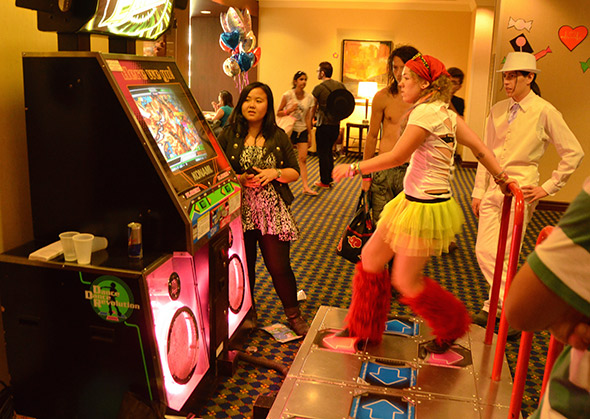
The turnout appeared to be better and perhaps a little bit older on average than last year. There was definitely a much higher ratio of cosplayers to ravers although there are boundaries being crossed between these two groups these days with plenty of partial costumes being worn by the dance crowd--think partial furry gear like full tails and ears along with the more fashionable furry boots and lots of beads.
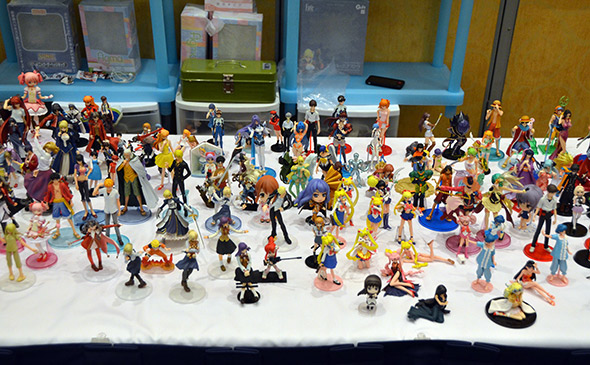
There were events for pretty much any inclination, with surprisingly large turnout for crafts workshops, which made sense once you realised just how much cosplay was going on. There were also plenty of vendors on-hand selling posters and other decor--figurines, manga and comics, makeup and accessories, candy, and caffeinated "Atomic Lollipops." There were even live snakes and other reptiles on display for people to touch and feel.
Out in the "playground"--for those willing to brave the heat and glare of the sun--there were deejays pumping out tunes from the big colourful Otakubaloo stage and some fun fair activities to take part in including a mechanical bull, bouncy castle, bouncy jousting, a big ferris wheel, and even cotton candy. For those who prefered to stay in the dark there was a games room (done up like a giant rec room) with all sorts of electronic and board games.
From what I could see this was a big success and will continue to grow in importance as an altternative to the more mainstream and established cons battling it out in the convention centre.
Find more photos here:
Speaking stones - Suiseki
Hobby Suiseki is the art of viewing stone. It can be as beautiful as music or poetry, says M. Ponnuswami as he shows his collection to K. Jeshi
In the book “The Japanese Art of Stone Appreciation”
, authors Covello and Yoshimuro describe how during the reign of the Japanese Empress Regent Suiko (AD 592-628), Chinese emissaries presented the Empress with a landscape stone. The Chinese, during their travels to Korea and Japan, are credited to have introduced the art of stone appreciation or Suiseki (Sui meaning water and seki meaning stone). A stone worthy of enjoyment, very similar to a painting, songs or poems. “A viewing stone invites you to introspect,” says M. Ponnuswami.
LOVE FOR BONSAI
A person, who admires and appreciates bonsai (a life member of Bonsai Club International, he is recognised as an international consultant by the World Bonsai Friendship Federation, U.S.), he also collects unique stones. “Suiseki was introduced as a complementary art to Bonsai. Now, it’s recognised as a separate art. Even as a small boy I was fascinated by the unique shapes and figures ofgonthu (gum) you find on the trunks of trees,” says Ponnuswami, who is Advisor (Soya) of Sakthi Sugars Limited.
His soon-to-be published coffee table book “Suiseki- The art of Stone Viewing” features images of 200 stones from his collection, all hand picked from streams, deserts, river beds, rocky mountains, sea shores and crater sites. The stones are usually displayed on carved wooden bases or on trays of sand. Ponnuswami’s collection of more than 500 stones have come from places as far as Jaipur, Udaipur and from the banks of the Yamuna, and the Cauvery. He also has a collection from the mountainous sites in Erode, Coimbatore, Karur, and Vavipalayam, a crater site near Palladam. Some of his semi-precious and crystal stones have come from quarries in Kangeyam.
Awareness in Suiseki is picking up in India, he says. The Bonsai clubs in Mysore and Bangalore give demos on how to collect stones. In 1998, Ponnuswami travelled all the way to China to show his collection. “I had to travel business class, because the stones alone weighed around 20 kgs! It’s an expensive hobby,” he jokes.
Magical shapes
The stones that lie on river beds and ocean shores are eroded into interesting shapes with holes and hollows. The surface of these stones suggest great age and evoke the grandeur of nature. You find rhythm and harmony in the patterns on these stones, he says. Pointing to a ‘Colorado Rock, intact with a multitude of layers, Ponnuswami explains, “It takes thousands of years for a single layer to form. So, imagine how old the stone is. It is possible to determine the age of stones from the marks on them.” The process of imagination is akin to meditation. When you start looking at it deeply the stone begins to reflect an image, he says. Some times the rocks represent mountains and natural wonders of the world; and at other times they may evoke ancient people, animals, and mythical creatures. He calls a green and white marble stone from Rajasthan a ‘Scenic Mountain’, with the white miniature lines on it representing waterfalls. “I came up with the names after a lot of contemplation,” he says.
While a rugged stone depicts ‘two friends in deep conversation’, a shiny yellow stone looks like a shoe. Most stones from his collection fall somewhere between fully explicit and totally abstract. Some are subtle, quiet, elegant and sedate while others are uncertain, vague and often puzzling.
He has a pre-sunset collection made up of beautiful stones in flaming yellows and oranges. He got them from Rajasthan. “You should have an eye for the stone, spot its unique structure, and formation, and appreciate its beauty, in order to be a collector,” he says. Some stones throw up interesting shapes when viewed from different angles. The shiny black stone that stares out of the cover of his book is shaped like an otter. There are also formations that look like the sphinx, a penguin, a loon bird of the U.S., and even bulls!
Meditative
A ‘saint’ rock in green and white is meditative. There is a stunning cheetah (a sea coral) that he found at Rameswaram. Another semi-precious yellow stone was picked up at Vavipalayam. An ‘Island stone’ is reminiscent of a chunk of cake. ‘Mountain full of streams’ is artistic and depicts the vastness of a mountain range. There is even a stone that looks like an old lady with wrinkled lines.
Suiseki is open to interpretation. A bright purple semi-precious stone looks like a flower in bloom to me, but Ponnuswami explains how to him it looks more like a mother and baby. Another stone in hues of pastel pink, violet and white represents the face of an eternal beauty (Elizabeth Taylor?). Turn the same stone around and it looks like a person with a haystack on his back. Ponnuswami believes every stone is priceless and awakens your soul. He says, “that is the beauty of Suiseki.”
Subscribe to:
Posts (Atom)
-
This beautiful photo is from the Takaragawa Onsen. Enjoying a hot, relaxing soak in the onsen while snow piles up around you is a "must...
-
It is a little known fact that before the samurai of ancient Japan incorporated the sword into their martial arts training, the samurai pr...
-
READING, Pa., Nov. 26 /PRNewswire-USNewswire/ -- The works of Edgar Degas were deeply influenced by Japanese art, yet surprisingly, there h...